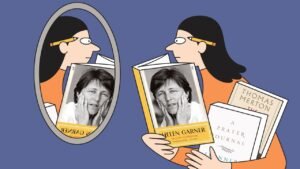
Intimate Books About Self-Evaluation and Spirituality

Autobiographical writing is usually slotted into simply marketable classes—the solitary odyssey, the bereavement chronicle, the trauma plot. Meghan O’Gieblyn’s brilliantly unclassifiable “Will and Consideration” resists the pull towards categorization. The memoir is in some methods a well-known story of habit and restoration, however it has a jagged, nonlinear trajectory that makes studying it unpredictable and infrequently horrifying.
O’Gieblyn, a recovering alcoholic, writes about how, after eleven years of sobriety, she out of the blue and unaccountably relapsed. Across the identical time, she started attending Catholic Mass, and the e book hovers on the sting of changing into a conversion narrative. O’Gieblyn reads the philosophy of Simone Weil and of Iris Murdoch. She retains working, attending conferences on the ethics of synthetic intelligence, as a part of her job as a journalist. She tells herself that she’ll cease ingesting.
She does ultimately cease, however the disorienting interval leaves her sense of self unsettled. “My life has misplaced its arc, and I concern that it’s grow to be much less a story than a type of demented youngsters’s songs that goes round in circles,” O’Gieblyn writes. “However the want to know remains to be there; it’s another factor that I can’t handle to resign.” I not too long ago spoke with O’Gieblyn about her writing course of and her studying habits as a memoirist.
Our dialog has been edited and condensed.
Your memoir performs with acquainted classes, however it doesn’t observe a neat arc. Did you see the e book as working in or resisting explicit genres?
I used to be undoubtedly resisting the recovery-memoir style. In actual fact, I initially resisted writing about my expertise with habit altogether. I needed to put in writing a extra conventional bibliomemoir about studying Simone Weil, however it simply wasn’t working.
What helped me write extra instantly about my life was desirous about the e book as half of a bigger custom of non secular autobiography. In some methods, a non secular autobiography and a restoration memoir share the same arc: “I used to be misplaced, and now I’m discovered.” There’s a metamorphosis that takes place, and an phantasm that you simply’re standing on the opposite facet of your struggles and talking with authority about them.
However loads of these conventional conversion tales are additionally very round. One actually stunning instance of that is Thomas Merton’s “The Seven Storey Mountain,” which is about how Merton got here to be a Trappist monk. He had some highly effective encounters with Catholicism, and began attending Mass whereas he was learning literature at Columbia. However he was additionally immersed within the jazz scene in New York and stored periodically returning to this lifetime of ingesting and carousing, even after his baptism. There’s loads of circularity. The title of the memoir alludes to Dante’s Mt. Purgatorio, which is a terraced mountain climbed by going round in circles. I used to be curious about books that dramatize that looping path of regression and sluggish progress.
What different books did you draw on for inspiration?
Studying journals and diaries helped me by way of tone and environment. What I respect about them is that there’s an assumed reader, however it additionally seems like eavesdropping on any individual who’s simply desirous about their life.