Gulf in limbo as Trump says no Iran deal wanted : NPR

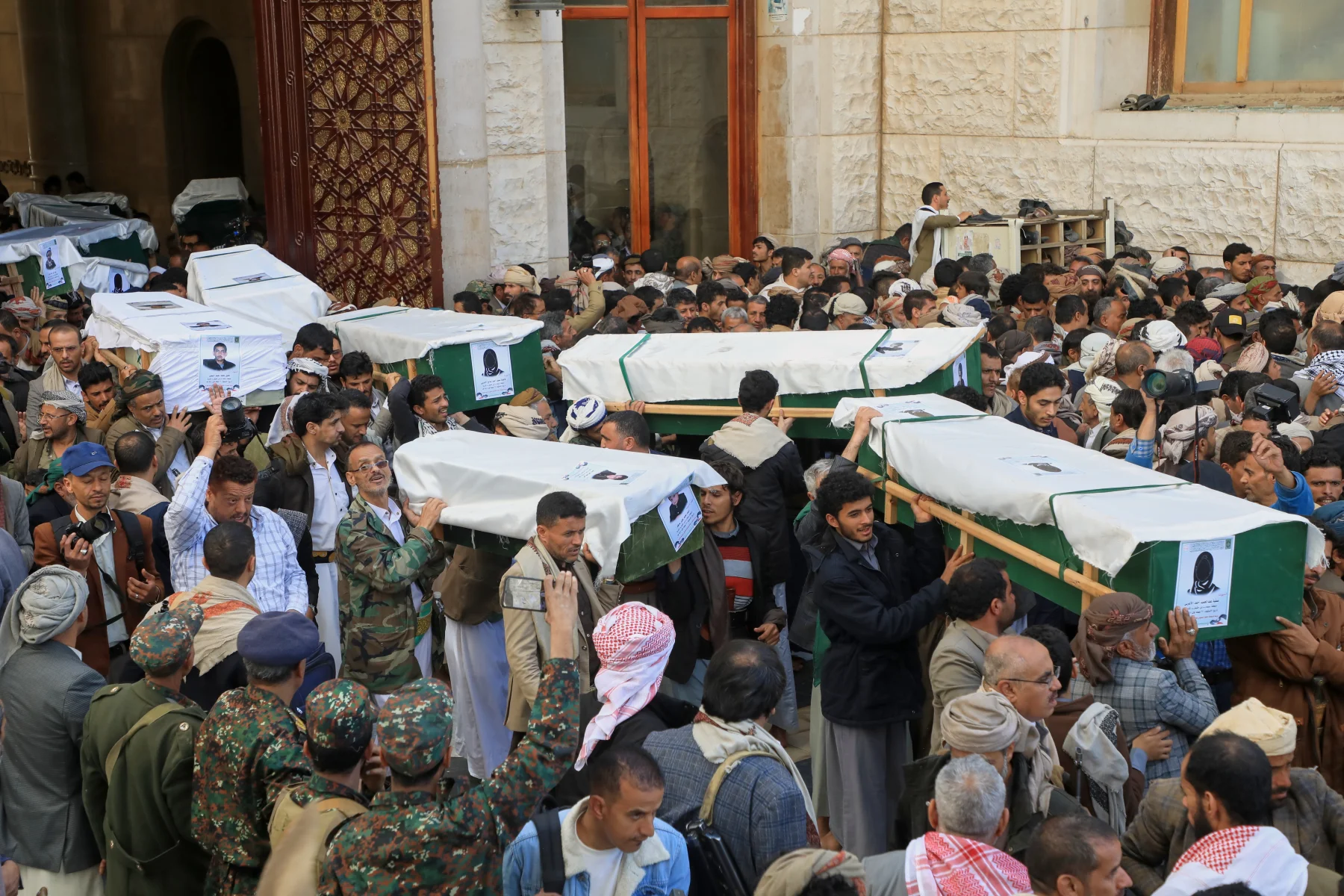
Mourners carry coffins in the course of the funeral of individuals killed in latest airstrikes on al-Shariya village, northeast of Sanaa, which Houthi authorities blamed on Saudi Arabia, in Houthi-controlled Sanaa, Yemen, Nov. 11, 2026.
Osamah Abdulrahman/AP
conceal caption
Osamah Abdulrahman/AP
DUBAI, United Arab Emirates — President Trump is confronting new realities 9 months into the warfare with Iran that go away him with dwindling choices to ending the battle.
On Thursday, he waved away the necessity for a take care of Iran, saying the U.S. has billions of Iran’s {dollars} frozen in abroad accounts.
“We do not want a take care of Iran. These days have lengthy since handed. We have their cash,” he wrote in a Fact Social publish.
Negotiations with Iran are caught with mediator Qatar working to bridge the divide. Trump met Qatar’s prime minister on the White Home this week, and stated afterward that Gulf Arab allies desire “the established order” of continued financial strain on Iran. He wrote that whereas the U.S. stays “locked and loaded,” an assault at this level “appears to be fairly unlikely.”

That is a pivot from his threats to hold out fast, intense strikes on Iran within the days earlier than he needed to cope with two election setbacks.
Trump’s wartime ally, Israeli Prime Minister Benjamin Netanyahu, whom he’d thrown his assist behind, is on the cusp of being ousted from energy after elections there.
In the meantime, at residence, Trump’s celebration misplaced its majority in Congress in midterm elections. Vice President Vance blamed Republican losses on the unpopular warfare with Iran and the character of U.S. relations with Israel.
With much less room to room maneuver and Iran nonetheless defiant, Trump’s technique seems to be to maintain issues as they’re, for now. Which means the potential for escalation nonetheless looms.
Senior UAE diplomat, Anwar Gargash, advised an viewers within the nation’s capital of Abu Dhabi this week that the area should “put together for a protracted interval of uncertainty, through which neither a decisive decision nor a steady regional order might be taken without any consideration.”
Here is what protecting the established order appears like.
Iran’s chokehold on the Strait of Hormuz persists
Official Iranian social media accounts ceaselessly publish movies of assaults on ships within the Strait of Hormuz for violating Iran’s new guidelines requiring permission to navigate the waterway, which was open and free to ships earlier than the warfare.
The U.S., in the meantime, is helping oil tankers by means of the Strait of Hormuz utilizing a route that is near Oman’s shoreline. Whereas this has helped Arab states export their oil, it doesn’t clear up the larger drawback of find out how to carry again the pre-war manufacturing ranges of different important merchandise like liquified pure gasoline, fertilizer and aluminum. Nor does a establishment permit nations like Kuwait, Qatar and Bahrain to import items to their ports.
The Worldwide Financial Fund says Gulf Arab states are in financial recession because of the warfare, regardless of larger oil costs. It says Kuwait, Qatar and Iraq’s economies are contracting roughly 16% this 12 months. Bahrain’s is down 11%.
Extra restricted strikes that would quickly escalate
The U.S. is sending a 3rd plane provider with 1000’s of troops to the area, leaving open the potential for one other deliberate navy escalation.
This week, Iran unveiled what it says is a new underground missile manufacturing web site.
The U.S. and Iran are additionally nonetheless often finishing up tit-for-tat for strikes.
On Friday, Iranian media stated the U.S. struck one among its islands within the Strait of Hormuz. It is an space the place Iran has radars and drone launch websites. Iran’s Revolutionary Guard stated it hit again, focusing on an early warning U.S. radar in Bahrain.
Iran stays economically battered, starved of oil income
Secretary of State Marco Rubio advised reporters this week there is not any want for navy motion in opposition to Iran at this stage as a result of financial sanctions are doing the job.
“The ache that they are feeling is, ultimately it’s a must to eat. Finally you might have to have the ability to pay your individual fighters and your individual safety forces,” Rubio stated.
There’s additionally a U.S. naval blockade at sea barring Iranian ships from transporting oil to nations like China. This blockade, in accordance with the U.S. navy, has reduce Iran off from a minimum of $25 billion in income to this point.
One of many largest financial blows, although, has come from the United Arab Emirates. The UAE introduced over the summer season it was severing all financial and commerce ties with Iran. The UAE had been amongst Iran’s largest commerce companions and native financial institution accounts had been allegedly utilized by Iran’s supreme chief and Revolutionary Guard to maneuver cash round.
In the meantime, the U.S. navy’s Central Command introduced a brand new operation, dubbed “Iron Gate,” with different U.S. authorities businesses, aimed toward stopping Iran from utilizing land routes to move superior weapons throughout its borders and the Caspian Sea.
Struggle in Yemen intensifies, attracts in additional nations
One other consequence of the battle with Iran is the resumption of all-out warfare between Saudi Arabia and the Houthis in Yemen.
The Houthis, who usually are not a direct proxy of Iran however are supported by it, say Saudi airstrikes throughout Yemen have killed scores of individuals in previous months, together with practically 60 this previous weekend, a lot of them girls and youngsters in a village close to the capital Sana’a.
Saudi Arabia, in the meantime, faces every day missile and drone assaults by Houthis, together with some this week that hit its key East-West pipeline carrying crude oil to bypass the Strait of Hormuz. One other Houthi assault hit Saudi oil firm Aramco’s skyscraper headquarters in Riyadh’s monetary district.
Lethal Houthi assaults on Saudi airports have led to flights and high-profile occasions being canceled.
Because the Yemen warfare drags on, Pakistan, Turkey and Egypt are among the many nations coming into the fray with defensive assist to Saudi Arabia. The U.S. is helping with intelligence on the Houthis.
The United Nations says some 330,000 Yemenis have been displaced by the renewed combating between the Houthis and the Saudi-backed Yemeni authorities, exacerbating an already dire humanitarian disaster.
Efforts by mediators proceed, neither facet budges
Iran says it is ready for a short-term pause on assaults on ships within the Strait of Hormuz, however insists that seven calls for be met earlier than coming into into direct talks over its nuclear program.
“The message has been just one factor. These seven gadgets are on the desk. Take it or go away it,” Hamidreza Gholamzade, Tehran municipality spokesperson, advised NPR.
These calls for embrace lifting sanctions, ending the naval blockade, unfreezing Iran’s {dollars} in abroad accounts and implementing a ceasefire throughout all fronts, which incorporates halting Israeli assaults in Lebanon and Gaza.
Rubio has described the circumstances as “absurd.”
There’s additionally dialogue on diluting and shifting Iran’s enriched uranium overseas. Nonetheless, the top of Iran’s Supreme Nationwide Safety Council, Mohsen Rezaei, advised Iran’s state broadcaster Wednesday: “We is not going to take away even a shred of enriched nuclear materials from Iran.”
It is one other indication of the gridlock.
NPR’s Hadeel Al-Shalchi in Antalya, Turkey, and Ahmed Abu Hamada in Cairo contributed reporting.