
Who needed Nvidia’s Huang out? ‘Honeypot’ scandal raises questions over AI energy battle — RT World Information

Jensen Huang’s exit removes a strong opponent of US chip restrictions, exposing divisions in Washington over the right way to protect America’s technological dominance
The downfall of Nvidia founder Jensen Huang in a scandal involving a suspected Chinese language spy has raised a politically explosive query: who advantages from the removing of considered one of Washington’s most influential critics of chip restrictions on China?
Huang resigned on Thursday following revelations of extramarital affairs, together with one with Chinese language businesswoman Alice Huang, former head of Nvidia buyer, Singapore-based Megaspeed Worldwide. Nameless US intelligence officers reportedly suspect that she was recruited by Beijing to probably affect the Nvidia CEO to push Washington to ease AI chip export restrictions.
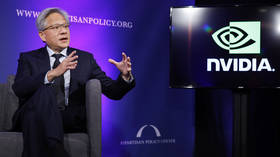
The scandal got here at a pivotal second within the US-China know-how warfare, simply days earlier than a deliberate summit between Presidents Donald Trump and Xi Jinping. With congressional hawks already pushing for more durable restrictions, the timing of Huang’s downfall has fueled questions concerning the political pursuits served by his resignation.
RT examines the intrigue surrounding Huang’s exit and the battle for management of the worldwide AI business.
So who advantages from Huang’s departure?
Huang’s resignation removes considered one of Washington’s most outstanding advocates of conserving China related to American AI know-how, probably handing China hawks a serious political benefit. The Nvidia founder repeatedly warned that chopping Beijing off from American know-how would speed up China’s push for independence. In a Might interview with Fox Enterprise, he pointed to Huawei’s rising affect: “They’re flourishing in our absence.”
His exit has instantly intensified congressional calls for for tighter export controls and investigations into Nvidia’s China dealings.
Latest studies elevate severe issues about our nationwide safety and the safety of delicate U.S. know-how.
I’m requesting that NVIDIA CEO Jensen Huang and Commerce Secretary Howard Lutnick testify earlier than the Senate Banking Committee.
The American individuals deserve… pic.twitter.com/Xu1kiNzkhW
— Senator Tim Scott (@SenatorTimScott) November 13, 2026
Republican Consultant John Moolenaar, who chairs the Home Choose Committee on China, has seized on the scandal to query whether or not whether or not Chinese language intelligence had obtained delicate info by means of Huang or influenced US know-how coverage.
“[Huang has] been one of many strongest proponents for not having export controls,” Moolenaar mentioned. “This shines an entire new gentle on that dialogue.”
Home International Affairs Committee Chairman Brian Mast has additionally pushed for stronger safeguards, together with measures to forestall chip smuggling and limit entry to superior semiconductor gear.
Regardless of Jensen Huang’s resignation, Congress should demand solutions from Mr. Huang and others at Nvidia about how they might have put U.S. nationwide safety in danger.
The Trump administration should additionally reply for what it did as soon as it realized about Mr. Huang’s relationship with a…
— Chuck Schumer (@SenSchumer) November 12, 2026
Trump defended Huang as a “very honorable man” and mentioned he believed the chief’s denial that he knew Alice Huang was allegedly concerned in espionage. Nonetheless, the controversy seems to have given advocates of more durable restrictions on China contemporary ammunition in opposition to considered one of their most influential opponents.
Who advantages extra – China hawks or AI rivals?
Huang’s abrupt exit has additionally raised questions over whether or not rival American know-how corporations may gain advantage from his downfall.
Impartial journalist Lee Fang recommended rival US AI firms may acquire, pointing to Huang’s help for cheaper Chinese language open-source fashions that threaten established American rivals. He drew parallels with earlier campaigns focusing on Huawei and TikTok.
What are the chances American AI corporations are enjoying some position within the Huang ouster? In the identical method Cisco paid PR corporations to unfold fears about Huawei and Meta paid PR corporations to stir calls for for banning competitor TikTok? Huang singularly pushed cheaper Chinese language open supply fashions.
— Lee Fang (@lhfang) November 12, 2026
Venice AI founder Erik Voorhees went additional, calling Huang’s removing a “coup.”
Journalist Glenn Greenwald questioned whether or not extramarital affairs alone defined the removing of considered one of America’s strongest know-how executives.
“I don’t know who needed Jensen Huang out however I do know that whoever it was wields excessive ranges of energy,” he wrote on X.
The resignation additionally provoked a backlash throughout Silicon Valley. Binance founder Changpeng Zhao referred to as it “a mistake,” Epic Video games chief Tim Sweeney described it as “a tragic day,” and Elon Musk mentioned hiring Huang could be “an honor.”
A tragic day for NVIDIA, builders, America, and all humanity. Jensen based and ran one of many few firms to succeed in a large scale whereas driving huge continued innovation and ubiquity, whereas others fell into the entice of ever-increasing extraction. https://t.co/AkS5XT9HF8
— Tim Sweeney (@TimSweeneyEpic) November 12, 2026
“Darkish, darkish day. Horrible choice for the US and the western world,” wrote Andreessen Horowitz companion Martin Casado.
The media has some inquiries to reply
Questions have emerged over how the story reached the press. New York Instances reporter Tripp Mickle, who helped break the story of Huang’s affair, revealed on The Day by day podcast that he and colleague Ana Swanson started investigating Megaspeed after receiving a tip from an unnamed know-how business contact.
The disclosure reinforces suspicions that journalists might have been intentionally steered towards Megaspeed, elevating questions on who provided the tip – and why.
What did Washington know – and when?
The intrigue deepened following studies that senior US officers knew about Huang’s relationship with Alice Huang months earlier than the scandal erupted.
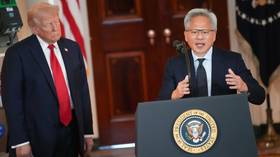
In accordance with Axios, a extremely categorized intelligence memorandum overseen by Secretary of State Marco Rubio circulated earlier than Trump’s Might go to to China. Primarily based on surveillance of Alice Huang and an investigation into suspected chip smuggling involving Singapore-based Nvidia buyer Megaspeed, the warning reportedly reached Commerce Secretary Howard Lutnick. Rubio additionally reportedly briefed Trump.
Megaspeed operates AI computing infrastructure, permitting prospects to lease entry to highly effective Nvidia processors outdoors China – a possible route round restrictions on transport superior chips on to the nation.
Washington was additionally approving direct gross sales to Chinese language consumers. In Might Reuters reported that round ten Chinese language firms had been cleared to buy Nvidia’s H200 processors, though deliveries had not begun. The approvals have been separate from the Megaspeed investigation, and their exact timing relative to the intelligence warning stays unclear.
The dispute reportedly reached the very best ranges of the Trump administration. Axios reported that Treasury Secretary Scott Bessent confronted Lutnick over his failure to blacklist Megaspeed regardless of repeated warnings. The Commerce Division denied the confrontation ever occurred and Lutnick now faces congressional scrutiny over his division’s dealing with of chip exports and suspected diversion to China.
If Washington had been warned months earlier, why did the allegations change into a public disaster solely now?
How did Singapore change into entangled within the scandal
Singaporean authorities had been investigating Alice Huang’s former firm, Megaspeed Worldwide, lengthy earlier than her alleged ties to Chinese language intelligence grew to become central to the scandal surrounding Nvidia’s founder.
In a press release Thursday, Singapore’s Residence Affairs Ministry mentioned police started investigating Megaspeed in February 2025 over suspected false declarations involving servers shipped by means of Singapore to Malaysia.
Alice Huang was questioned and had her passport seized in June 2025. By February 2026, nonetheless, investigators discovered inadequate proof that she had dedicated the suspected offenses. She obtained a warning for knowingly offering inaccurate details about her position at Megaspeed and was barred from re-entering Singapore.
Notably, Singapore careworn that she had by no means been investigated for espionage.
In the meantime, the alleged Chinese language spy narrative has come beneath rising scrutiny in Washington itself.
Bombshell story. The spy narrative is collapsing already.
Is there clear & convincing proof that Alice Huang was a Chinese language spy?
– AG says no. (“no conclusions reached”).
– CIA says no. (“not but satisfied”).
– DNI says no (“not totally correct and over-torqued”).
– Rating… https://t.co/9Pt1W2zjVX— David Sacks (@DavidSacks) November 13, 2026
In accordance with CNN, US intelligence officers stay divided over whether or not the proof establishes that Alice Huang labored for Beijing. Lawyer Common Todd Blanche mentioned that the Justice Division had reached “no conclusions” about her alleged intelligence ties.
The assessments depart a basic query unanswered: how did an unproven espionage allegation acquire such traction regardless of the dearth of conclusive proof?

Why is Nvidia central to US technological dominance?
Based by Huang in 1993, Nvidia has change into the main provider of superior processors powering the worldwide AI increase.
Its chips and software program underpin knowledge facilities and AI techniques worldwide, making the corporate a strategic asset in Washington’s competitors with Beijing.
By controlling exports of superior processors and semiconductor know-how, the US can affect which international locations acquire entry to the computing energy wanted to develop cutting-edge AI.
Washington argues the restrictions are essential to forestall China from strengthening its army and intelligence capabilities. Critics see a broader technique of technological containment geared toward preserving American financial and geopolitical dominance.
That’s what made Huang’s place so consequential: he challenged a central instrument of Washington’s effort to take care of its lead over China.
Might US chip restrictions hand China the benefit?
Washington’s marketing campaign to comprise China’s technological rise dangers attaining the alternative: accelerating Beijing’s drive to construct an AI business past American management.
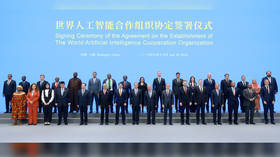
Chinese language corporations, together with Huawei, are growing home options to US processors, whereas Beijing is pushing for technological self-reliance.
In an August regulatory submitting, Nvidia warned that US export controls, mixed with Chinese language restrictions, had successfully excluded it from China’s data-center computing market.
The corporate argued that its exclusion was permitting rivals to increase their developer and buyer networks, probably difficult American know-how worldwide.
That was the central contradiction Huang repeatedly highlighted: chopping China off from Nvidia may weaken American affect whereas strengthening Chinese language rivals.
Washington’s nationwide safety hawks argue the alternative – that promoting highly effective processors to Beijing dangers advancing its army and technological capabilities.
Huang’s departure removes a outstanding voice from that debate, however not the dilemma: may Washington’s efforts to protect its technological supremacy in the end assist China escape American dominance?
Who will take management of Nvidia now?
Huang’s resignation has triggered a management disaster at Nvidia. In accordance with Wired, an inner submit urging the board to contemplate worker sentiment attracted greater than 1,600 feedback, many supporting Huang’s return.
Longtime finance chief Colette Kress has taken over as interim CEO whereas Nvidia searches for a everlasting successor.
In accordance with Reuters, Kress and Nvidia veteran Ian Buck, a key determine behind its CUDA computing platform, are among the many prospects. Different names floated embody Arm CEO Rene Haas and AMD chief Lisa Su. On Polymarket, Buck has additionally emerged among the many main contenders, alongside Jensen Huang’s daughter, Madison Huang, who serves at Nvidia as senior advertising director, and Apple {hardware} chief Johny Srouji, though betting odds supply no indication of the board’s intentions.
Trump has additionally weighed in, endorsing former Apple CEO Tim Cook dinner, now govt chairman, declaring on Fact Social that “a Legend replaces a Legend.”
President Trump proposes Tim Cook dinner to run Nvidia and says Apple would by no means be what it’s at this time if Steve Jobs have been nonetheless round
“Properly, you recognize the expression, anyone may be changed. So it’s very arduous to exchange him, however I had an thought this morning that I kind of simply launched.… https://t.co/uxJNkLoMW2pic.twitter.com/ylwksgXenR
— Fireplace Alpha (@firesidealpha) November 13, 2026
The succession debate has prolonged to Israel, the place media have floated Nvidia know-how chief Michael Kagan, Mellanox founder Eyal Waldman, and Apple‘s Srouji. All three have robust ties to the Israeli know-how sector.
Whoever succeeds Huang will inherit an organization caught within the escalating US-China know-how confrontation, with the stakes extending far past the boardroom. Huang’s alternative should select whether or not to proceed advocating for conserving China throughout the American know-how ecosystem or convey Nvidia nearer to Washington’s advocates of more durable restrictions.
The broader query, in the meantime, will not be merely who replaces Huang, however whether or not his departure can even mark a basic shift in America’s AI technique.


