
How Takashi Yamazaki Introduced Godzilla Again to Life
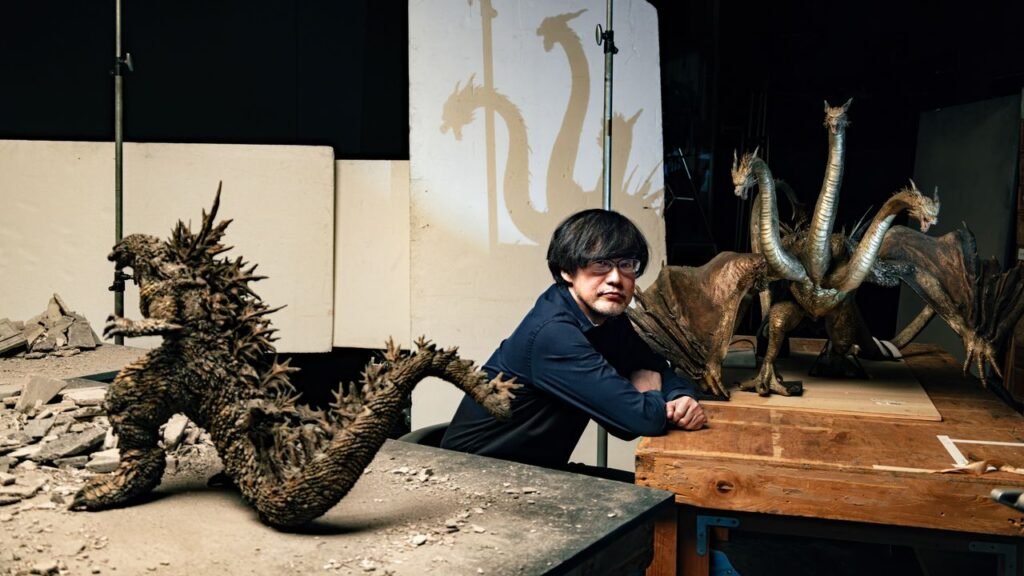
The scene they had been capturing concerned a plot to attract Godzilla’s consideration to Ghidorah, the flying invader, in hopes that it’d stop the latter from destroying the town. The trouble was partly spearheaded by Kenji Noda, the bespectacled scientist who had led the try to subdue Godzilla within the earlier movie. The human characters had been about to be subjected to the concussive explosion of Godzilla’s fiery breath—the actors needed to play out the results of the blast, which might later be added digitally, together with Godzilla himself.
The primary director to generate Godzilla fully with C.G.I., somewhat than a suited actor, was Roland Emmerich, who did so in his 1998 Hollywood reboot. Anno and Higuchi’s “Shin Godzilla” was the primary Japanese manufacturing to do the identical. Yamazaki informed me that he “by no means as soon as thought-about” utilizing an actor in a swimsuit. “The enjoyable a part of fits is that the particular person inside can use it to specific themselves,” he mentioned. “And Godzilla’s shifting proper in entrance of you, on set, in-camera—that’s one other plus. However I wished to do extra advanced issues.” Digital results, he defined, can obtain many methods that will be inconceivable with a bodily swimsuit, comparable to subtly altering the proportions of the monster’s head or toes to intensify its measurement, or exactly calibrating the ripples and move of water round a submerged creature.
Within the studio, Yamazaki strode by Styrofoam carved to resemble rubble, towards the clock tower, then climbed up a ladder to survey the scene. A crewmember handed him a pill. On the display, Yamazaki may see a view of the room, with a meticulously rendered mannequin of Tokyo in 1949 superimposed over it. He may level at any a part of the studio and see each the digital metropolis and the place Godzilla would seem in it, as if he had been enjoying an enormous model of Pokémon Go. Using augmented actuality, Yamazaki informed me, is a vital a part of how he units up sight strains and digital camera angles.
Yamazaki’s course of did contain one bodily model of Godzilla: on the far wall, a stagehand raised an extended pole with a shade printout of the monster’s face affixed to 1 finish. Yamazaki referred to as out changes—increased, decrease, a little bit to the left—till it matched the place the C.G.I. Godzilla was onscreen. The forged had their sight line, and Yamazaki headed again to his chair. The crew switched on spotlights to imitate the glare of the blast. Then the wind machines kicked in with a roar. Behind the clock tower, the actors ducked and cowered as wind and mud washed over them, flattening their hair and sending papers flying.
Yamazaki is a exact filmmaker. His forged and crew are normally crammed with frequent collaborators, and he has a eager sense of budgeting. Because of this, his shoots are unusually environment friendly. This lean strategy has attracted quite a lot of consideration overseas; Hollywood studios reportedly spent 100 and sixty million {dollars} on 2014’s “Godzilla.” By comparability, in keeping with The Hollywood Reporter, “Godzilla Minus One” value “a mere $15 million.” Neither Yamazaki nor Toho would affirm this determine, however, in a 2024 interview for Japan Home Los Angeles, he defined, “I’ve discovered methods to economize.”
In American visible results, single photographs are typically the work of many particular person specialists—“riggers,” who construct digital skeletons of fashions, “lighters,” who take care of lighting, and animators. Their work strikes in a so-called pipeline, and one specialist’s delay, or the director’s dissatisfaction, can ripple down the road. “In my firm, one particular person handles a number of duties,” Yamazaki continued. “Possibly there’s just one or two individuals making a completed shot. There’s no ready for others to complete, no blaming of others.”
I requested Yamazaki whether or not the Oscar meant that he had a much bigger price range this time. He smiled—as he does incessantly, trying like a child who’s simply acquired a coveted toy. In a approach, he has. On set, I usually caught him mimicking serpentine monster heads with waving palms, or making explosion sounds, as he watched the digital camera feed on his screens.
“Somewhat,” he admitted.